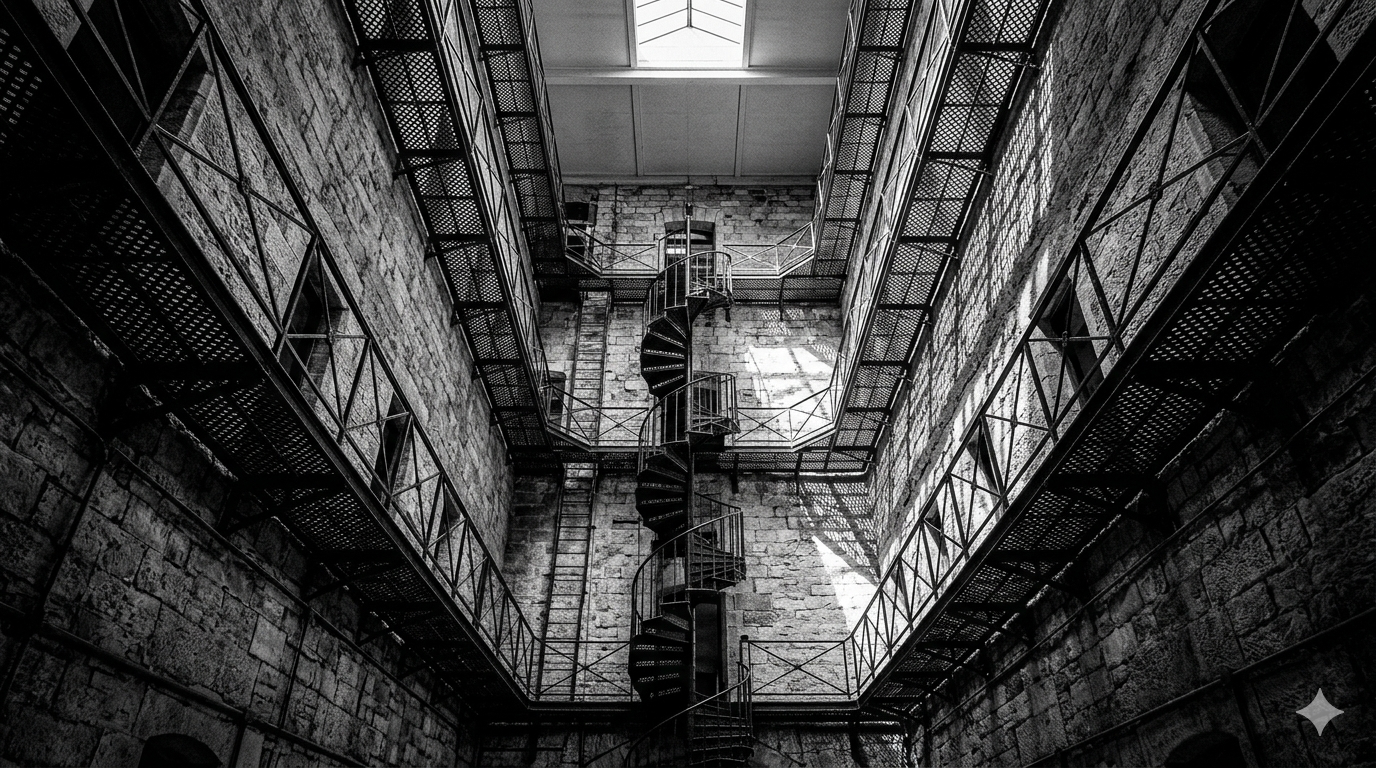
If the nomad "sheds skins" to find freedom, the orphan must "wear the dead" to survive. This unit complements the Ondaatje unit, and examines Grace Marks as the orphan of Empire—an Irish immigrant subject marginalized by English Loyalist elites following the 1837 Rebellion, who navigates the rigid legal and medical structures of Victorian Canada by stitching together a patchwork identity from the memories and clothes of the deceased. Bridging the IB Diploma Program English Literature focus on fragmented perspective and unreliable narration with Undergraduate Literary & Critical Theory shift to engage Foucault 's notions of Biopolitics and the Panopticon, and the impact on multivalent cultural negotiations with power.
Michel Foucault: Biopolitics & The Docile Body
We explore the Penitentiary and the Asylum as sites where the "orphan" body is governed. Grace’s "silence" is framed as a resistance against the biopolitical urge to categorize her as either murderess or victim.
Giorgio Agamben: Bare Life
Positioning Grace in the state of "inclusive exclusion." As an immigrant without standing, she is reduced to "bare life"—a body that can be punished but not heard, existing only in the "skin" the state allows her.
The 1837 Rebellion: Colonial Hegemony
Analyzing the novel's setting against the failed democratic uprisings. We examine how the "English" legal structures in Canada were designed to suppress the Irish/Scots immigrant classes viewed as a threat to loyalist order.
Patchwork Stylistics: Constructing the Archive
Quilting functions as a counter-hegemonic strategy. We analyze Grace’s unreliable narrative as a way of "weaving" a history that destabilizes the "striated" official record of the colonial press.