Museum of the Moving Image — Kubrick Collection

The Reading Cinema

Imperfect Texts, Perfect Film · Luhrmann, Scott, Cuarón, Kubrick

Pedagogical Framework

This unit advances a central heresy: the dominant orientation to adaptation — that the book is original, the film derivative — is not merely naïve but critically incurious. Working across four text/film pairings, students examine a recurring move in canonical cinema: directors diagnosing the structural flaws of their source texts and producing the film as the theoretically informed correction. The director, on this argument, is functioning as a literary critic — identifying what the text suppressed, what it was reaching for and could not hold, what it formally could not deliver, and encoding the response in cinematic decisions.

The course is built around a 60-minute plenary lecture that establishes the central argument across all four cases, followed by four discrete 90-minute seminars, each opening one text/film pairing in greater depth. The seminars precede the lecture — students arrive at the plenary having already done close work on a pairing, giving them a stake in the argument before they hear it made in full. Designed for advanced secondary and early undergraduate contexts, the unit bridges IB DP English and Undergraduate Film and Literary Studies, drawing on a shared theoretical vocabulary from adaptation theory, deconstruction, and philosophy of cinema.

Theoretical Anchors

Linda Hutcheon: A Theory of Adaptation
Hutcheon's foundational argument is that adaptations are neither translations nor copies but palimpsests — texts existing in continuing dialogue with their sources, layered and simultaneous. Her distinction between telling, showing, and interacting modes provides the vocabulary for all four seminars, allowing students to map how the shift from prose to cinema reorganizes the audience's relation to the material. The fidelity question — "was the film faithful?" — is, on Hutcheon's account, the wrong question. The right question is what the film reads in the book.

Harold Bloom: Strong Misreading
Bloom's claim that the history of literature is the history of strong misreading — creative, agonic, transformative encounters with a precursor — is transplanted here to the history of canonical adaptation. These directors are not translating their sources; they are misreading them in Bloom's precise sense: diagnosing what the text did not know about itself and producing the correction. Luhrmann misreads Shakespeare's centre; Scott misreads Dick's binary; Cuarón misreads James's genre; Kubrick misreads Clarke's kernel.

Jacques Derrida: The Supplement
The supplement — that which appears merely to add to what is already complete, but turns out to expose a lack at the heart of what looked whole — provides the structural argument of the lecture. The four films are supplements in Derrida's exact sense: each appears to expand its source, and each reveals, on examination, what was missing from the source all along. The supplement converts the discussion of adaptation into a discussion of what reading is when reading is given all the tools of cinema.

Marshall McLuhan: The Medium is the Message
McLuhan's argument from Understanding Media — that any medium reorganizes the scale and pace of human attention regardless of content — is the theoretical apparatus for Seminar 1 and frames the entire course argument. The question of what cinema can do that prose cannot is, at its core, a McLuhanesque question. Kubrick's most daring move is to enact McLuhan's claim rather than illustrate it: the monolith and the screen share aspect ratio. The film has been showing us the monolith all along by being one.

The Plenary Lecture · 60 Minutes

The lecture establishes the course's central argument — adaptation as critical practice — moving through all four cases in sequence and building toward a general claim about the relationship between cinema, criticism, and what reading looks like when given a budget, a crew, and 70mm of celluloid.

0–8 min
Opening · A Heresy About Fidelity
The book-was-better orientation is not just naïve — it is critically incurious. The lecture's premise: certain canonical films are great because their source texts are flawed, and the films undertake to address those flaws. Hutcheon and Derrida introduced as the two theoretical companions for the hour.
8–19 min
I · Romeo and Juliet — The Play Whose Centre Was Hidden
Luhrmann's diagnostic moves: centering Juliet's cognition over Romeo's, reading the Friar as a renegade, modernizing the speed of feudal Verona rather than its period. Clip cue: Verona Beach opening. The tomb-scene chronology shift — Juliet wakes before Romeo dies — as feminist re-reading. The film has a thesis; it argues that thesis by being it.
21–34 min
II · Blade Runner — The Binary That Wanted to Collapse
Scott's diagnosis of Dick's flat protagonist and half-developed Baudrillard. The Derridean–Nietzschean reversal of the human/android binary: the hierarchy collapses; undecidability is the endpoint. Clip cue: "Tears in Rain." The Rachael scene as colonial-capitalist-erotic logic exposed through blocking, lighting, and the line "I am the business."
34–47 min
III · Children of Men — The Pilgrimage Buried in the Diary
Cuarón's identification of the latent Byronic hero and the pilgrimage structure. The long take as formal opposite of James's diary — exteriority and duration against interiority and editorial control. The shoes motif. The citational apparatus — Guernica, Pink Floyd, Bowie — as cinematographic essay. Clip cue: car ambush single take.
47–59 min
IV · 2001 — The Screen That Was Always the Monolith
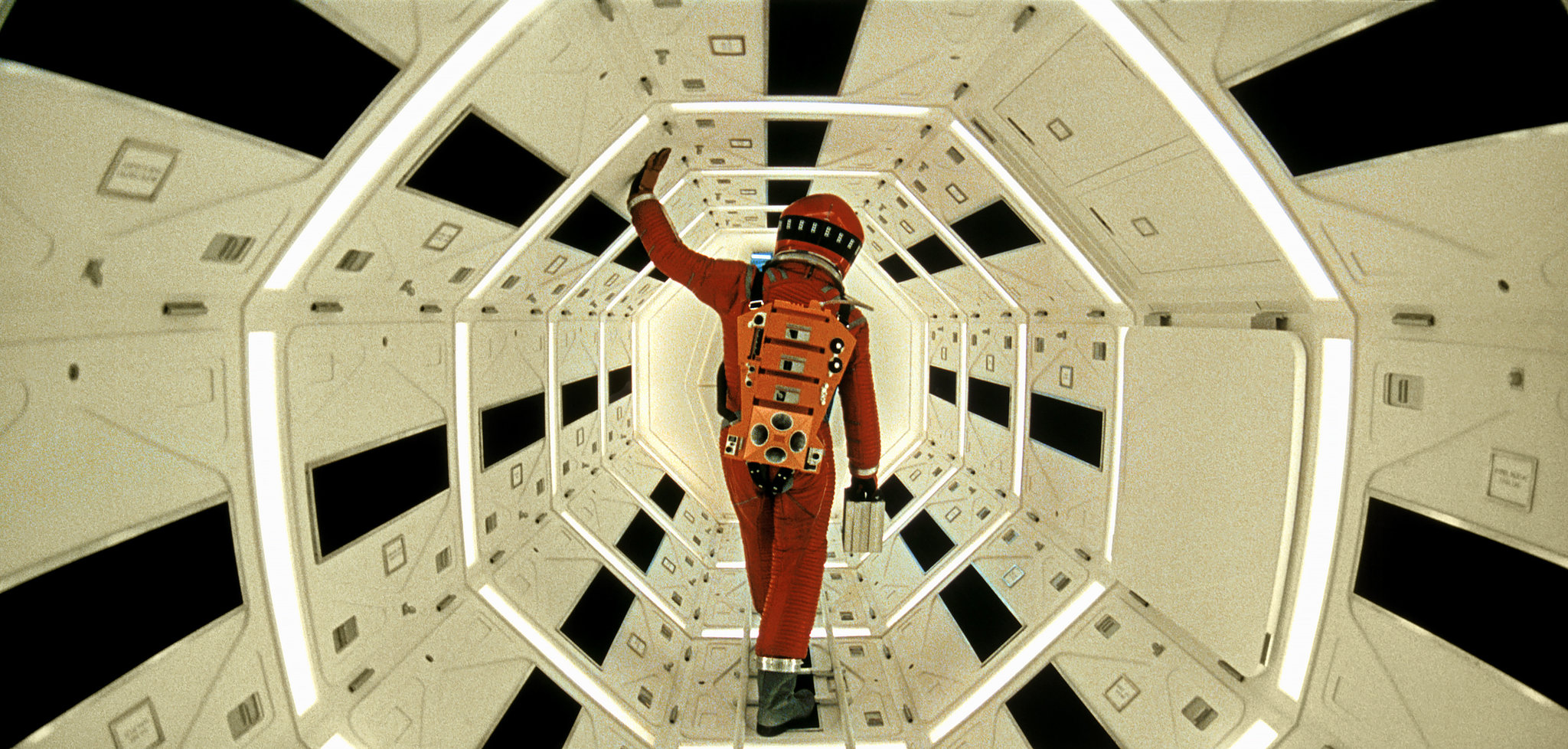
Kubrick's expansion of Clarke's eight-page kernel into Nietzschean cosmology. The monolith as Eternal Return — three encounters, three transfigurations. HAL as Will-to-Power figure. The monolith's aspect ratio as the cinema screen's aspect ratio: the McLuhan move enacted, not illustrated. Clip cues: bone-to-spaceship cut; final monolith approach and Star Child.
59–67 min
Synthesis · The Reading Cinema
The history of canonical adaptation is the history of strong misreading. The four diagnoses consolidated. Closing provocation: if directors can be critics, can critics be directors? What does it mean that our medium — the seminar paper, the lecture, the monograph — is so much narrower than theirs? Adaptation is criticism. Criticism is, in its highest reaches, adaptation.

The Four Seminars · 90 Minutes Each · 8–11 Students with TA

Each seminar opens one text/film pairing in advance of its appearance in the lecture. Students arrive having read the source text, watched the film, and completed two scholarly readings — one general (transferable theoretical vocabulary), one specific (argumentative essay on the film). The seminar's job is to convert that purchase into argument. All four plans share the same internal arc: warm prompt, reading-anchored task, scene-anchored task, and an exit ticket that bridges to the lecture. The sequence is intentional: Kubrick first, because the source-to-film gulf is largest and the course's structural argument is most undeniable there; Cuarón last, because by week four students should be capable of holding two competing readings in tension without collapsing the disagreement.

Seminar 1
Arthur C. Clarke, "The Sentinel" & Stanley Kubrick, 2001: A Space Odyssey
The match cut · the screen-as-monolith
General McLuhan, "The Medium is the Message," Understanding Media (1964) — ~14 pp
Specific Michelson, "Bodies in Space: Film as 'Carnal Knowledge,'" Artforum 7, no. 6 (1969) — ~10 pp
Primary Clarke, "The Sentinel" (1951) — ~8 pp
Warm prompt (index cards: what can the film do that the story cannot?) → McLuhan applied in pairs across three sequences: the bone cut, HAL's death, the Star Child → re-screen final 4 min, Michelson on carnal knowledge and the spectator's body → structured disagreement: faithful expansion vs. refutation of Clarke's prose → exit ticket. Climactic insight: turn the monolith ninety degrees. Do not give it away early.
Seminar 2
William Shakespeare, Romeo and Juliet & Baz Luhrmann, William Shakespeare's Romeo + Juliet
Transposition · visual figuration of language
General Hutcheon, A Theory of Adaptation, Ch. 1: "Beginning to Theorize Adaptation" (2006) — pp. 1–32
Specific Pizano, "Speaking Without Words: Luhrmann's Adaptation of Romeo and Juliet," Interdisciplinary Literary Studies 21, no. 4 (2019)
Primary Shakespeare, Romeo and Juliet — Acts I, III.i, and V at minimum
Warm prompt (one moment that does the same thing; one that does completely different things) → Hutcheon's three modes in small groups: Prologue, balcony scene, Queen Mab, death scene → Pizano's claim tested in pairs: the tomb-scene chronology shift as the film's reading of the play → Zeffirelli debate (more faithful vs. more rigorous are different claims; let the room clarify which standard they're voting on) → exit ticket.
Seminar 3
Philip K. Dick, Do Androids Dream of Electric Sheep? & Ridley Scott, Blade Runner
Production design as theoretical argument
General Baudrillard, "The Precession of Simulacra," Simulacra and Simulation — ~25 pp
Specific Bruno, "Ramble City: Postmodernism and Blade Runner," October 41 (Summer 1987) — ~14 pp
Primary Dick, Do Androids Dream of Electric Sheep? — especially chs. 9, 16, 18, and the close
Warm prompt (one thing the novel does well that the film abandons; one thing the film does well that the novel cannot) → Baudrillard's three orders in small groups: replicant photographs, the Voight-Kampff test, the city of LA, Rachael's memories → Bruno on the city as theory: pairs on opening flyover, Chinatown sequences, Bradbury Building → re-screen the Rachael apartment scene; give students permission to name what they see → exit ticket: Is Deckard a replicant? Argue from formal choices only.
Seminar 4
P. D. James, The Children of Men & Alfonso Cuarón, Children of Men
The long take · the citational background
General Bazin, "The Evolution of the Language of Cinema," What Is Cinema? vol. 1 (1967) — ~17 pp
Specific A Žižek, "The Children of Men Comments," DVD commentary transcript (2007) — ~5 pp
Specific B Trimble, "Maternal Back/grounds in Children of Men," Science Fiction Film & Television 4, no. 2 (2011) — ~20 pp
Primary James, The Children of Men (1992) — read in full
Warm prompt (who is the protagonist in the film? in the novel? is this the same question?) → Bazin and the long take in pairs: coffee-shop explosion, car ambush, Bexhill battle — what is preserved by the absence of the cut? → Žižek vs. Trimble structured disagreement: foreground/background and racial-reproductive grammar — do not let the disagreement resolve too quickly → re-screen: Guernica, the Pink Floyd pig, the shoes → exit ticket: If criticism is what these directors do, what is criticism?

Global Discourse

Linda Hutcheon: On Adaptation Theory — The author of A Theory of Adaptation on the palimpsest, the fidelity debate, and what it means for a film to "succeed" relative to its source. Slavoj Žižek: The Pervert's Guide to Cinema — Žižek on the ideological unconscious of Hollywood film; directly applicable to the Blade Runner and Children of Men seminars. Stanley Kubrick: A Life in Pictures — Documentary on Kubrick's practice, his relationship with source material, and his insistence on cinema as a form of philosophical argument.

Unit Deliverables

Download Lecture Script Download Seminar Plans