


Education · AI
AI for Student Assessment—Is this the Wild West of Bullshit, or Not?
April 2026
+
Screenplay
Paros
PDF
Essay · Politics
Orwell Doesn't Matter
April 2026
+
Essay · Literature · Politics
The Hegemon Refuses to Read
April 2026
+
Essay · Political Economy
The Cartographer at the Edge of Empire
May 2026
+


Education · AI · Assessment

AI for Student Assessment—Is this the Wild West of Bullshit, or Not?

The Disagreement Is the Finding

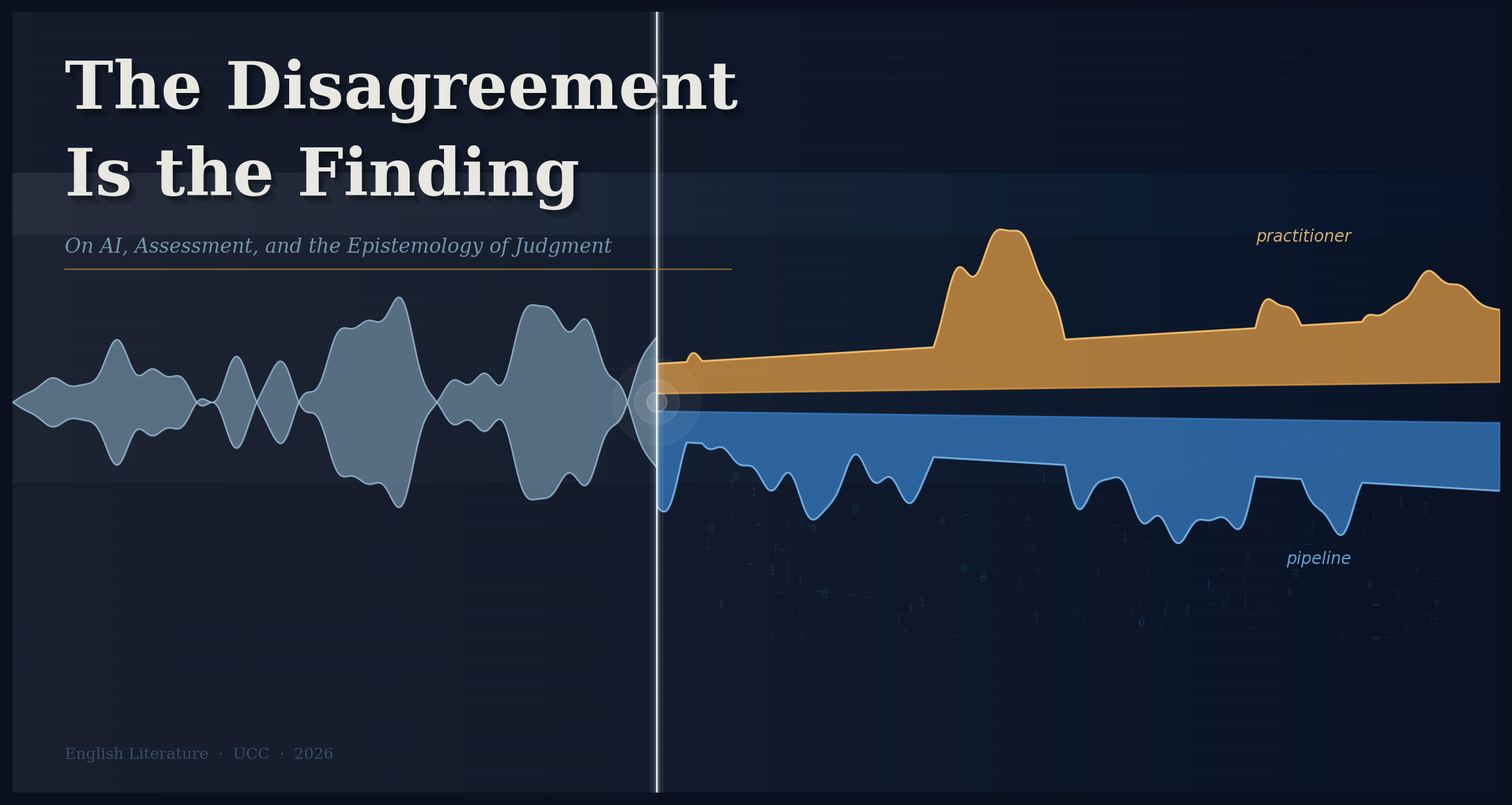
Let me tell you about an experiment I recently did with a few AI platforms (for full disclosure Google's Gemini and Anthropic's Claude) and asked them (them?) to evaluate student work both in the basic, commercially available platforms—a rubric, a video essay, and then something more elaborate, two semi-agentic bots I designed (Gem and Cowork) that had task-specific clarifications and deeper frontloading of interpretive contexts.

That's the right instinct...I think…

The educator community is exactly where this lands with the most force—because we are the ones being asked, with increasing urgency, to have a position on AI in assessment. And most of the conversation is stuck in the wrong place: can students use it to cheat, and how do we detect it?

I say, who cares?

Why let this ruin your day, or ruin the relationship you have with a student?

I have detractors. You can only imagine…

What I built to test this reframes the question entirely. The interesting pedagogical problem isn't AI as threat to assessment integrity—it's AI as a mirror for what assessment actually is. When two differently-structured systems evaluate the same oral analysis and reach different conclusions about student A's organisation or student B's criterion knowledge, that's not a failure of the technology. That's the technology revealing something that was always true and usually invisible: that assessment is an interpretive act, not a measurement. And now my post-structuralist Spidey senses are tingling…

For an educator audience, the demonstration has a few layers they could, and should, unpack: The first is epistemological—what does it mean to know a student performed at a 4 versus a 5? The second is methodological—what do inter-rater reliability protocols actually protect against, and what do they miss? And the third, which is the one that might genuinely shift practice, is this: if two AI systems disagree about a student's oral analysis in the same way two human examiners might, then the response isn't to trust one more than the other—it's to treat the disagreement itself as information, and to teach students to do the same with their own interpretive disagreements about texts.

That's a course in critical thinking wrapped inside an assessment methodology story. A riddle wrapped in a mystery, wrapped inside an enigma. Uh-oh…


What Actually Happened

Let me start with a small experiment.

A student delivers an oral examination. He speaks for approximately ten minutes about Wordsworth's Tintern Abbey—confidently, fluently, with a sophisticated grasp of context and an original interpretive formulation at the end that could fairly be described as the most intellectually impressive moment of any oral in his cohort.

Two assessors evaluate his performance—the typical moderation move. Both are working from the same rubric. Both are attending to the same criteria. Both are appropriately caffeinated. One gives him 17 out of 20. The other gives him 16.

This isn't a story about incompetent marking. It isn't even a story about inconsistency. It is, I want to argue, a story about what assessment actually is—and it becomes considerably more interesting when I tell you that neither of those assessors was human.

The experiment I'm describing was not designed as an experiment. It emerged from a practical workflow that many teachers working with AI tools will recognise: a pipeline (a stack) that takes student video submissions, transcribes them automatically using Whisper (OpenAI's speech-to-text model), passes those transcripts to a large language model for assessment against a rubric, and generates a formatted feedback document.

The second assessor was the same underlying model—Claude—but working manually, in conversation, having watched the video, and then read a transcript of it.

The discrepancies, when we laid them out side by side, were illuminating. For the student in question—let's call him Henry—the pipeline gave him Criterion A: 4/5, missing the interpretive sophistication of what he'd actually argued. The manual assessment gave him Criterion A: 5/5, with a specific note about his coinage of the phrase "reconstructive education" as an original critical formulation. The pipeline couldn't find that phrase because Whisper hadn't heard it clearly.

A different student—Jack—lost two full marks to the pipeline, including a C criterion score of 3 instead of 4, because his structural approach was read as "recursive" rather than recognised as the sustained, argument-driven organisation it actually was. And perhaps most instructively: the pipeline penalised a third student for apparently misusing the term "diction"—writing that he should "watch for slips such as 'addiction' for 'diction'"—when in fact the student had said "diction" perfectly correctly. Whisper had simply misheard him, and the model downstream had taken the transcript at face value, turning a transcription error into a language penalty.

Here's the thing. We could stop the story there and draw the obvious conclusion: AI assessment pipelines are unreliable, students were disadvantaged, the technology failed. That conclusion is not wrong. But it is, I think, incomplete—and stopping there means missing something genuinely important about what this experiment revealed.


What the Literature Has Been Trying to Tell Us

Assessment theory has had a complicated relationship with the concept of reliability for a long time.

The dominant paradigm in assessment for much of the twentieth century was psychometric: the idea that good assessment is reliable assessment, meaning that different assessors evaluating the same performance should reach the same conclusion. Inter-rater reliability—the statistical measure of agreement between assessors—became the gold standard of assessment quality. If two markers disagree, one of them is wrong, or the rubric is ambiguous, or the training was insufficient. The goal was convergence. Statistical validity becomes a knowing joke at the pub…and then we're all talking about statistics, validity scores, Pearson point coefficients.

Carol Gipps, in her landmark 1994 work Beyond Testing, argued that this paradigm had fundamentally misconceived what educational assessment is doing. Psychometric reliability, she suggested, was borrowed from a measurement model designed for stable, objective phenomena—lengths, weights, temperatures—and imposed on something categorically different: the evaluation of a human performance that is irreducibly interpretive, contextual, and relational. Assessment, Gipps argued, is not measurement. It is judgment. And judgment, unlike measurement, is not improved by pretending it is objective.

My father, a nuclear physicist, would identify this discrepancy as the phenomenological differences between soft science and hard science.

D.R. Sadler's influential 1989 paper on formative assessment identified what he called "guild knowledge"—the tacit, accumulated understanding of quality that experienced assessors develop and that cannot be fully articulated in a rubric. It is what I call the 'black art' of IB assessment, broadly, comprehensively. Expert assessors, Sadler observed, don't simply apply criteria mechanically. They attend to the whole performance, they notice what is remarkable, they situate what they see within a mental model of the range of possible performances, and they make a judgment that is, in the end, irreducibly interpretive. The rubric is a scaffold for that judgment, not a replacement for it.

More recently, research in oral and multimodal assessment has pressed this point further. Gunther Kress and others working in multimodal communication theory have argued that performance-based assessment is evaluating something fundamentally different from what written transcripts can represent: the voice, the pacing, the confidence of a claim delivered in real time, the way a speaker's intonation can make the same words carry more or less interpretive weight. When Henry says "reconstructive education" in a way that signals he has arrived at the formulation rather than rehearsed it, that arrival is part of what is being assessed. A transcript cannot carry it.

None of this literature was written with AI assessment in mind. But it might as well have been.


The Mirror the Machine Holds Up

Here is the reframe I want to offer: the disagreement between our two AI assessors is not a bug in the technology. It is the technology doing something that human assessment has never managed to do quite so visibly—making the interpretive gap between reading a performance and attending to a performance legible.

When two human examiners mark the same oral examination and reach different conclusions, we have institutional mechanisms for handling that. We average the scores. We have a senior examiner adjudicate. We run calibration sessions. We train toward convergence, building elaborate algorithms of statistical validity. All of these mechanisms are designed, at some level, to suppress the disagreement rather than examine it—because in an examination context, divergence is a problem to be resolved rather than information to be used.

What happens when the disagreement is between a pipeline and a practitioner? Suddenly we have to look at why they disagree. And when we do, we find something instructive: the pipeline failed Henry not because its rubric was wrong or its training was insufficient, but because it was working from a degraded representation of his performance. It was reading a transcript. The practitioner was attending to a voice.

This distinction—between reading and attending—is, I would argue, precisely what Sadler's "guild knowledge" is about. It is what Gipps meant when she said assessment is judgment, not measurement. And it is what the IB oral examination is designed to test: not a student's ability to produce an analyzable text, but their capacity to think interpretively in real time, in a register that is simultaneously analytical and personal, about a work of literature that requires both.

The pipeline didn't fail because AI can't assess. It failed because the wrong version of AI was asked to assess the wrong representation of the thing being assessed. That's a design problem. And design problems are solvable.


The Ideological Assumption I'm Asking You to Make

I want to be direct about the position I'm arguing from, because I think it matters for how educators engage with this question.

The dominant conversation about AI in assessment is structured around threat: students using AI to evade assessment, AI producing outputs that undermine academic integrity, the possibility that assessment becomes meaningless in a world where language models can generate plausible responses to any prompt. These are real concerns. I'm not dismissing them.

But the assumption embedded in the threat narrative is that assessment, as currently practised, is basically right—and that AI is a force that corrupts it. I want to propose the opposite assumption: that assessment, as currently practised, has always had profound epistemological problems that we have managed through convention rather than resolved through inquiry, and that AI—used thoughtfully—might be the most powerful tool we have ever had for surfacing those problems and thinking about them honestly.

Inter-rater reliability has always been a proxy for something we couldn't quite measure. Two examiners agree; we call the result valid…no need for z-scores and SD calculations. But agreeing examiners might both be missing the same thing—the thing that only reveals itself to the assessor who is genuinely attending, as opposed to the one who is efficiently processing. The pipeline's failure to notice Henry's "reconstructive education" formulation is not fundamentally different from a tired examiner's failure to notice it. The difference is that the pipeline makes the failure visible in a way that a tired examiner, producing a plausible-sounding rationale, does not.

That visibility is valuable. It should be welcomed, not suppressed.


What This Means for Practice

I don't think the conclusion here is "use AI for assessment" or "don't use AI for assessment." I think the conclusion is considerably more interesting: use AI for assessment in ways that generate productive disagreement, discourse even, and then teach students—and teachers—to examine that disagreement.

Imagine showing a student two assessments of their oral: one generated by a pipeline from a transcript, one produced by a practitioner who watched the video. Ask the student: why do these differ? What does the pipeline miss? What does the practitioner notice that the transcript can't carry? What does that tell you about what you were actually doing when you were doing your best?

This is not a failure-state scenario. It is one of the richest assessment conversations a student and teacher could have. It is, in miniature, a lesson in hermeneutics—in the idea that texts (and performances, and transcripts of performances) do not carry stable meanings that a sufficiently trained reader will reliably extract. Meaning is made in the encounter between a reader and a text, shaped by what the reader attends to, what they bring, what they are listening for. Gadamer called this the "fusion of horizons." Bakhtin called it dialogue…love that guy…we should read him more often. Assessment theorists have been circling it for thirty years without quite naming it.

AI has named it. Accidentally, in the gap between a pipeline and a practitioner. But named it nonetheless.


A Note for the Educator Community Specifically

If you are in a room with other educators talking about AI and assessment, I want to leave you with one provocation.

The conversation we need to be having is not: how do we stop AI from undermining assessment?

It is: what does AI reveal about what assessment has always been?

And the answer, I think, is this: assessment has always been an interpretive act, performed by a situated reader, shaped by what they attend to and what they miss, structured by conventions that produce reliability without guaranteeing validity, and improved—when it is improved—by the quality of attention that an experienced, engaged practitioner brings to a human performance.

AI doesn't change that. It makes it visible.

And visibility, in education, is almost always the beginning of something better.


This piece emerged from a classroom assessment project at the University of Toronto, Cultural Studies, English Literature Oral Analysis submissions on Wordsworth's "Tintern Abbey." The observations about inter-rater discrepancy are drawn from a comparison of pipeline-generated and practitioner-generated assessments of the same student performances. No student names have been used in the public version of this piece.

Key references: D.R. Sadler, "Formative Assessment and the Design of Instructional Systems" (1989); Carol Gipps, Beyond Testing: Towards a Theory of Educational Assessment (1994); Paul Black & Dylan Wiliam, "Inside the Black Box" (1998); Gunther Kress, Multimodality: A Social Semiotic Approach to Contemporary Communication (2010); Hans-Georg Gadamer, Truth and Method (1960/1975).

Essay · Politics · Criticism

Orwell Doesn't Matter

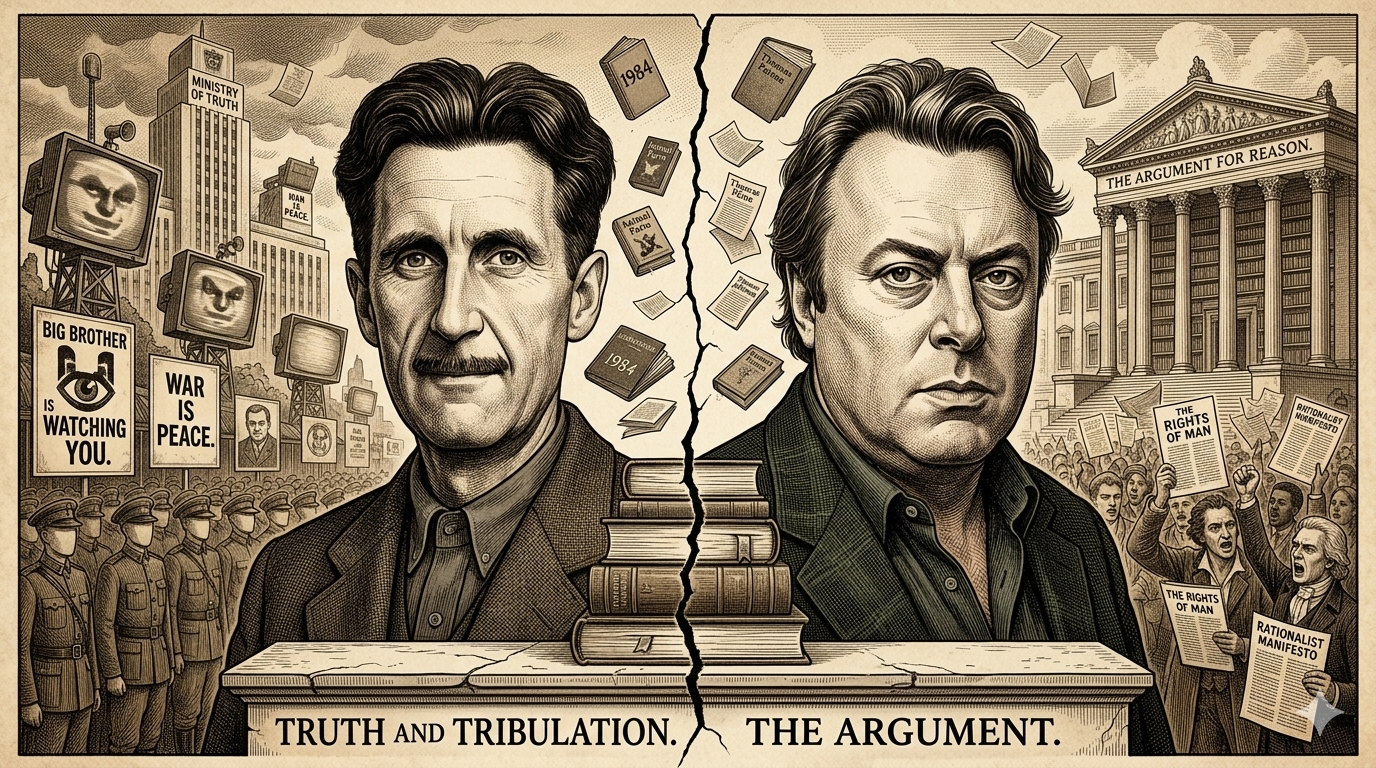
Truth and Tribulation. The Argument.

There is a particular kind of intellectual mourning that comes not from losing someone you knew, but from slowly losing the framework they gave you. Christopher Hitchens died in December 2011, and I have been losing him ever since — not the man, but the certainty he modelled. The precision of his contempt. The way he could walk into a room of received wisdom and light it on fire with a single subordinate clause.

Why Orwell Matters, published in 2002, is Hitchens at his most defiant and most tender. It is a book written against forgetting — against the comfortable burial of inconvenient voices under the weight of institutional indifference. Hitchens wanted Orwell rescued from two opposing fates: appropriation by the right, who claimed the Animal Farm allegory as simple anti-communist propaganda, and dismissal by the left, who could never quite forgive him for the list, for the informing, for the refusal to perform solidarity when solidarity cost nothing. Hitchens argued, with characteristic force, that Orwell mattered because he had faced the totalitarian temptation and named it honestly — not from safety, but from within the contradictions of committed political life.

I believed him. For a long time, I believed him completely.


Here is what I believe now: Orwell doesn't matter. Not because Hitchens was wrong about what Orwell did or said. But because the culture that would allow Orwell to matter — the culture that requires a certain kind of reader, a certain quality of political attention, a certain shared commitment to language as a truth-bearing instrument — that culture is gone. And its disappearance is, in some uncomfortable way, something Orwell's own legacy helped to accelerate.

Let me try to explain what I mean.


When Hitchens wrote his defence, the central worry was misappropriation. Orwell was being cited by people who hadn't read him, or who had read him selectively, to justify positions Orwell would have found repugnant. The specific targets of Nineteen Eighty-Four — the Ministry of Truth, the memory hole, the two minutes hate — were being laundered into general-purpose intellectual currency, stripped of their historical specificity and deployed against anyone the speaker happened to dislike. Big Brother became a bumper sticker. Doublethink became a term of casual abuse.

Hitchens' response was to insist on the specificity. Read Orwell whole. Read him in context. Read the Catalonia chapters, the essays on nationalism and on language, the journalism from the colonies. Understand that the man's power came from his insistence on seeing what was actually there, regardless of what the correct-line demanded he see.

This was, and remains, an admirable intellectual position. The problem is that it presupposes an audience capable of that kind of reading — and more than that, an audience that accepts the premise that careful reading of a canonical figure is a legitimate way of arriving at political truth.

That audience no longer commands the conversation. It hasn't for some time.


The Post-Structural Problem

Post-structuralism, which Hitchens famously and sometimes intemperately dismissed, has done something to the category of the political writer that cannot be undone by pointing to the quality of the work. Foucault's insight — that knowledge is never innocent of power, that the speaking subject is always positioned, always implicated — has become, in its vulgarised form, a universal acid. It dissolves authority. All authority. Including the authority of the person who first insisted on dissolving it.

Orwell is, by contemporary critical standards, a deeply compromised figure. The colonial service in Burma. The list of suspected communists provided to the British government's Information Research Department — a list that included, among others, people marked as Jewish or "too Negro," in Orwell's own hand. The paternalism embedded in his treatment of working-class subjects in The Road to Wigan Pier. The women in his fiction, who exist largely as functions of male consciousness.

None of this is secret. Hitchens knew most of it and argued, reasonably, that it had to be weighed against the whole. That a man writing in the 1930s and 40s carried the ideological residue of his formation was not a disqualifying condition — it was a condition of being human and historical.

But here is the post-structural problem Hitchens could not fully resolve: if the standard we apply to Orwell is the standard of seeing clearly, of refusing the convenient lie, of following the evidence wherever it leads regardless of whose ox is gored — then the evidence about Orwell himself is not comfortable. The man who celebrated unvarnished honesty was, in specific and documentable ways, not honest. The man who identified with the powerless was, in specific and documentable ways, an agent of their surveillance.

You cannot ask people to adopt Orwell's epistemology — see clearly, name truthfully, resist the party line — and then ask them to set that epistemology aside when it turns its gaze on Orwell. The instrument doesn't know who made it.


A Reason to Grieve, Not to Abandon

This is, I want to be clear, not a reason to abandon the project Hitchens was engaged in. It is a reason to grieve it. And the grief matters, because what has replaced it is not a better epistemology. It is no epistemology. It is pure affect, pure tribal identification, pure will to power dressed in the language of whoever happens to be speaking.

We are living through a global political moment that Orwell diagnosed with extraordinary precision and that has, precisely because of the failure of his prescriptive legacy, become nearly impossible to arrest.

Look at the landscape. Viktor Orbán has systematically dismantled the institutional architecture of liberal democracy in Hungary, not by abolishing elections but by making them meaningless — controlling the media environment, gerrymandering constituencies, subordinating the judiciary. Narendra Modi has conducted a decade-long project of majoritarian nationalism in the world's largest democracy, turning the instruments of democratic legitimacy against the minorities those instruments were designed to protect. Vladimir Putin has constructed something genuinely novel: an authoritarian kleptocracy that wraps itself in the aesthetic language of civilisational defence, positioning himself as the bulwark against a decadent West while systematically murdering political opponents and flattening the cultural infrastructure of a neighbouring people. Marine Le Pen — or rather, the political formation she represents, now increasingly led by younger figures who have shed even her father's cruder edges — has brought the rhetoric of ethnic sovereignty into genuine electoral contention across France.

These are not accidents. They are not simply the product of demagogic genius or foreign interference, though both have played their roles. They are the product of a specific kind of political hunger that Orwell identified and that we have systematically failed to address: the hunger for clarity, for enemies, for the comfort of a world divided into those who belong and those who threaten belonging.

Orwell's warning was not primarily about the strongman. It was about the population that wants one. Nineteen Eighty-Four is not, at its deepest level, a book about O'Brien. It is a book about Winston Smith — about the person who knows better and cannot hold that knowledge against the weight of exhaustion, isolation, and the terrible seductiveness of being told what to think.

We are all Winston Smith now, and we have no Inner Party to blame for it. We did it ourselves, through the long attrition of public discourse, the financialisation of attention, the replacement of political argument with political performance.


And Then There Is America

And then there is America, which is where this failure becomes most morally acute and most intellectually difficult to bear.

America positioned itself, for the better part of a century, as the institutional guarantor of a particular kind of international order. That order was always self-serving, often hypocritical, frequently violent in its own right. But it carried within it, however imperfectly, a normative architecture — a language of rights, of sovereignty, of accountable governance — that could at least be used to hold it to account, to argue against its own violations on its own terms.

That architecture is now functionally inoperative.

In Ukraine, the response to a textbook case of imperial aggression — a nuclear power attempting to erase a neighbouring state's right to exist — has been managed with such incoherence, such strategic ambivalence, such subordination of principle to domestic political calculation, that it has become impossible to articulate what the defence of Ukraine is actually for, beyond the immediate humanitarian emergency. In Gaza, the gap between stated values and observable reality has become so vast, so well-documented, so geometrically undeniable, that the language of international law and human rights has itself been destabilised — not by the people violating it, but by the failure of its supposed guardians to apply it consistently. And now, as the shadows lengthen over Iran, we are watching the same machinery of selective moral attention grind into motion again, producing not clarity but noise.

Orwell's word for this was nationalism, which he defined not as love of country but as the habit of identifying a human collective as an instrument and judging all actions by whether they serve it. The nationalist, Orwell wrote, does not need to be consistent. They need only to be on the right side.

We have built, globally, a political culture of pure nationalist epistemology. And we lack, now, the institutional or intellectual resources to name it — because the figure who gave us the clearest language for naming it turns out to have been, in his own life, more implicated than we were told.


The Wrong Question

I still read Hitchens. I still feel the pull of that voice, the pleasure of that mind at full velocity. And I think he was right about what Orwell achieved, at the level of the work and the prose and the courage.

But Hitchens asked the wrong question. The question is not why Orwell matters. The question is why we could not make his mattering matter — why we took the warning and turned it into a brand, took the epistemology and turned it into a cudgel, took the clear-eyed dissidence and domesticated it into a pose.

Orwell gave us the tools. We built a gift shop.

The shop is very popular. Outside, the century is proceeding as he described.


If you've found this useful, share it — not because it will change anything, but because the habit of sharing difficult thoughts is one of the few things left that distinguishes a public from an audience.

Essay · Literature · Politics · Education

The Hegemon Refuses to Read

Wild Thorns — Prickly Pear

The syllabus is a political act.

In 2015, I was teaching in Bangkok. I am Canadian, and I have a British passport too. I speak English natively, French adequately, and Japanese well enough to get into trouble at izakayas. I am white. Blue eyes even. I have spent the better part of my adult life deliberately inhabiting cultural contexts in which I am the foreigner, the outsider, the one who doesn't know the reference—and I have tried to let that experience inform what I put on a reading list.

That year, I assigned Sahar Khalifeh's Wild Thorns.

This was not a neutral decision. No syllabus decision is, though most educators pretend otherwise. Choosing what students read is the most consequential curatorial act a teacher performs, and the pretence of neutrality—of simply teaching "the best that has been thought and said"—is itself a political position, one that happens to align remarkably well with the interests of whoever decided what "best" meant in the first place. I had read enough Said, Fanon, and Spivak to know that, and I had read enough of the canon itself to know that exclusion is never accidental.

So, I made intentional decisions. I kept the dead white guys—the British ones especially, the Americans—largely off my lists. Not out of ignorance of their merits, but out of a considered judgment that my students could find Orwell anywhere, and that what they couldn't easily find was a Palestinian woman writing in Arabic in 1976 about what it actually felt like to live inside a military occupation.

What I did not anticipate was that someone else was paying attention to my reading list.


The Novel

Wild Thorns is not a polemic. This is the first thing to understand about it, and the thing that makes it literature rather than argument.

Khalifeh published the novel in Arabic in 1976, two years before Edward Said published Orientalism and gave Western academia the theoretical vocabulary to discuss exactly what she was already doing in fiction. The novel follows Usama, a Palestinian man who returns from working in the Gulf to his hometown in the occupied West Bank, committed to armed resistance—and Adil, his cousin, who works in Israel, supports his family on Israeli wages, and has arrived at a pragmatism that Usama reads as collaboration and betrayal.

Khalifeh does not resolve this. She is not interested in resolving it. The occupation grinds both men equally—the idealist and the pragmatist, the resister and the accommodator—and the novel's moral architecture refuses to distribute guilt tidily. What it renders, with the precision of someone who lived it, is a surveillance structure so total and so intimate that it deforms every relationship, every choice, every ordinary transaction of daily life.

My students, most of whom had never heard of the West Bank, read this in six weeks and arrived, independently and without prompting, at Michel Foucault's panopticon.


The Embassy

In early 2016, I received an email.

It was from the Israeli Embassy in Bangkok, and it was politely worded in the way that emails from embassies tend to be when they are not quite threatening you. The ambassador—and, I later learned, a Bangkok station operative whose precise institutional affiliation I will leave the reader to infer—had become aware that I was teaching Khalifeh's novel in an English-language university course. They wished to visit my class. To offer, as they put it, the other side of the story.

I want to be precise about my own position here, because it matters. I am not, and was not, a partisan of any armed faction. I am the kind of tedious liberal (Dad was literally an English Trotskyist) who spent years defending the two-state solution at dinner parties, the kind of person who believes in international law with the weary sincerity of someone who has watched it ignored often enough to know that belief and efficacy are not the same thing. I was not assigning Wild Thorns as propaganda. I was assigning it because it is a serious work of literature by a serious writer that my students were otherwise never going to read.

I replied to the email.

I told them they were welcome to come and address my class. On one condition: they had to read the novel first.

I never received a reply.


The Classroom, Five Times

I taught Wild Thorns for five years, to five cohorts of students, in an English-language program in Thailand. My students were Thai, with the occasional international student from elsewhere in Southeast Asia, and they came to the text with no inherited position on the Israeli-Palestinian conflict—no family narrative, no religious stake, no political formation that told them in advance what to think.

Every cohort arrived at the same conclusion.

Not the same opinion—the novel does not traffic in opinions—but the same structural diagnosis. The occupation, they said, was a panopticon. The watchtower from which all is observed and nothing is certain. The mechanism by which the observed internalise the gaze of the observer until surveillance becomes self-surveillance, and the architecture of control no longer requires its enforcers to be present. They arrived at Foucault without being assigned Foucault, because Khalifeh had built the structure so precisely that the theory was implicit in the fiction. And, to give fair time to the ambassador, Khalifeh didn't even build it. Ben Gurion did. Golda Meir did.

This is what literature does that theory cannot. Said's Orientalism—which I did teach, which I continue to teach—tells you that a system of representation exists that positions the East as object and the West as subject, that produces knowledge as a form of power, that renders certain peoples permanently legible and others permanently opaque. It is a great and necessary book. But it cannot make you feel the checkpoint. It cannot put you inside the body of a man who must decide, every morning, whether to take Israeli wages and feed his children or to refuse and maintain a dignity that the occupation is specifically designed to make unaffordable.

Khalifeh does that. And so, my students felt it, five years running, and reached for the nearest theoretical framework available to describe what they'd felt. The same framework, every time. Because the structure was the same, every time. Because the occupation hadn't changed.

The novel wasn't a perspective. It was a diagnosis.


The Recursive Loop

Here is the problem with the anti-canon.

Said, Fanon, Spivak—these are now canonical texts. They are assigned at elite universities in English, published by Western academic presses, cited in tenure applications, taught in the same institutions that produced and maintained the literary canon they critique. The challenge to Western cultural authority was absorbed by the machinery of Western cultural authority and issued back as methodology. We got the framework for reading the exclusion without reading what had been excluded.

This is not an accusation. It is a structural observation, and Said would have recognised it immediately, because he spent his career navigating exactly this recursive trap—the Palestinian intellectual whose critique of Western representation was itself only legible, only consequential, only safe to assign, because it arrived in the approved form, in English, from a Columbia professor.

What this produced, in practice, was a generation of educators who could discourse fluently on Orientalism and had never read a line of Khalifeh. Who could explain the subaltern's exclusion from representation without assigning the subaltern's actual representations. Who taught the map of the blind spot rather than looking at what the blind spot contained.

I include myself in this indictment, partially. I made better choices than many. But I also assigned Said before Khalifeh, and I will not pretend that was entirely innocent.

The anti-canon has its own canon. And the canon, as always, is more comfortable than the literature it describes.


The Shylock Scene

In one of the years I taught the novel—the third, I think, though the years compress—something happened that I have thought about ever since, and that I can only describe as the essay's entire argument being performed in real time, in the form of a failed flirtation.

Two students—young Thai women, sharp, engaged, the kind of readers who annotate in three colours—had become friendly with a Jewish student who had joined the program from abroad. They were, in the way of students, interested in him. He was, in the way of some people, interested in his own opinions.

They had read Wild Thorns. They had processed it through Foucault, as their cohort did. And then, in conversation with this student one afternoon, they reached—without prompting, without a syllabus to direct them—for The Merchant of Venice. For Shylock. For the speech.

If you prick us, do we not bleed? If you tickle us, do we not laugh? If you poison us, do we not die? And if you wrong us, shall we not revenge? The villainy you teach me I will execute, and it shall go hard but I will better the instruction.

They were not quoting it as literary criticism. They were pointing at something they had identified—the logic by which the wronged party learns the methods of the wrongdoer and applies them with greater efficiency—and reaching for the most precise language available to name it. The most precise language available happened to be Shakespeare. The dead white guy. The very canon I had deliberately excluded.

The student defended Netanyahu. He defended the settlements, the Golan Heights, the management of Gaza. He had, as far as I could tell, not read Khalifeh, and was not planning to.

The young women lost interest. Not in outrage—in something quieter and more final. The specific disappointment of people who have done the reading encountering someone who has decided the reading is unnecessary.

That moment contains the essay's argument in miniature. Two students from a country with no stake in the conflict, assigned a Palestinian novel in an English-language classroom in Bangkok, reached for Shakespeare to name what they'd understood—and the person whose identity was most implicated in the conversation had nothing to say that engaged with any of it. The subaltern was quoting the canon back at the hegemon. The hegemon wasn't listening.


The Close

The war in Gaza has now passed its fourth year.

The two-state solution—which I defended to the Israeli embassy, implicitly, as evidence of my good faith, as proof that I was not assigning Khalifeh as a provocation but as literature—has been rendered functionally moot. Not by Palestinian intransigence, but by decades of settlement policy that made a contiguous Palestinian state geometrically impossible, and then by a military campaign that has made the language of political resolution sound, to many ears, obscene.

Wild Thorns did not predict this. Prediction implies contingency, the possibility that events might have gone otherwise. What Khalifeh wrote was a diagnosis of a structure—the logic of occupation, the deformation of daily life, the impossible arithmetic of resistance and accommodation—and structures, when left unaddressed, tend toward their conclusions. The novel knew what the occupation was in 1976. In 1976 I still had all my baby teeth, for context. The conclusion has been unfolding in real time, and the people who might have read it earlier were busy assigning Said instead.

I want to be precise about what I mean when I say the embassy's silence was academically dishonest. I do not mean dishonest in the sense of lying. I mean dishonest in the sense that every serious intellectual tradition I am aware of—including the Western one, including the canonical one—holds that you cannot dispute what you have not read. That engagement with a text precedes judgment of it. That the refusal to read is not a neutral position but a choice, and a choice with consequences. To read Khalifeh is to be inside the structure. To be inside the structure is to have to account for it. To have to account for it is to lose the clean conscience that makes the structure operable.

The hegemon refuses to read. This is not incidental to power. It is a mechanism of it.

The syllabus, it turns out, is more dangerous than the argument. The embassy knew that. My students knew it. Two young women who reached for Shakespeare to explain Gaza to a boy who hadn't done the reading knew it, and then, predictably and admirably, moved on.

Wild Thorns has been available in English translation since 1985. It is not long. It is not difficult. It is, on the evidence of five consecutive cohorts of Thai undergraduates who came to it with no prior formation and left it with a structural analysis of occupation that has only become more precise with time, extraordinarily teachable.

Put it on a list. See who objects.

Essay · Political Economy

The Cartographer at the Edge of Empire

Mark Carney — pencil portrait

There is something genuinely unprecedented about Mark Carney's political emergence, and it is not what the financial press tends to celebrate. The Goldman Sachs alumnus turned dual central bank governor turned UN climate envoy turned Canadian Prime Minister is regularly framed as the apotheosis of technocratic virtue: sober where his contemporaries are histrionic, systemic where they are reactive, globally literate where they retreat to nativist fantasy. All of this is true, and none of it captures the deeper dialectic his career enacts.

What Carney actually represents is something the theoretical tradition has long anticipated and political commentary has been slow to name: the emergence of a new form of sovereignty-without-centre, a mode of governing that is neither the old Westphalian state-power nor the naïve cosmopolitanism that briefly passed for globalism in the 1990s. He is, in Fredric Jameson's resonant phrase, attempting a "cognitive map" of a totality that no longer has a legible geometry—and the problem is that the paper he draws on was manufactured by the very cartographic tradition whose maps have failed.

To evaluate Carney seriously is to hold two registers simultaneously: the conjunctural (the specific political moment of post-Trump American unilateralism, Canadian trade vulnerability, and European strategic anxiety) and the structural (the deeper logic of what Hardt and Negri called Empire, the biopolitical management of populations, and the question of who constitutes the political subject of any post-hegemonic order). The conjunctural analysis has been done competently elsewhere. It is the structural register that demands attention.


Empire Without a Centre

Hardt and Negri's Empire (2000) made an argument that initially appeared counterintuitive and has since become unavoidable: the United States does not and cannot occupy the centre of Empire in the way that European imperial powers occupied the centre of their dominions. American hegemony was always, structurally, a network phenomenon—operating through multilateral institutions, financial architectures, legal norms, and military alliances rather than through direct territorial administration. The sovereign power exercised through this network is not American imperialism in any classical sense; it is something genuinely new, a form of governance that distributes sovereignty across nodes while reserving override for the most powerful state actors.

Trump's second administration represents not the exercise of that override power but something more structurally significant: an attempt by the United States to exit the network while retaining its benefits. The tariff regimes, the casual threats to Canadian sovereignty, the documented flirtation with Alberta separatism as a deliberate destabilization tactic aimed at punishing Ottawa—these are not misunderstandings of the rules-based order. They are an attempt to re-territorialize power: to reassert a Westphalian sovereignty that Empire's own architecture had rendered obsolete, and to use the resulting disorientation as leverage against former partners.

The U.S. Treasury Secretary's flirtation with Alberta separatism is less a mispricing of risk than a deliberate destabilization tactic. No amount of careful talk about resilience will deter that kind of behavior.
— Carney Policy Review, Open Canada, 2026

This is the geopolitical context Carney has entered, and he has understood it more clearly than most of his counterparts. His repeated assertion that the post-war order "is not returning"—that economic integration has been weaponized and that middle powers must build new forms of collective resilience—is not merely a diplomatic repositioning. It is a structural diagnosis. When he describes tariffs and payment systems as "instruments of coercion" rather than natural market phenomena, and frames the new landscape in terms of "variable geometry"—different coalitions for different issues, overlapping rather than hierarchical—he is describing, without the theoretical apparatus, something close to what Hardt and Negri meant by the distributed sovereignty of Empire: a polycentric system of governance without a single uncontested centre.

What he has not yet fully grasped—and here Hardt and Negri's framework becomes diagnostic rather than descriptive—is that reconstituting a middle-power network still operates within the logic of Empire rather than against it. The question of who benefits from this reconstitution, and through what forms of political subjectivity, remains largely unasked within Carney's framework. His visits to Qatar and China early in his mandate, the active courting of European and Indo-Pacific partners, the framing of Canada as a platform rather than a proxy—these are the institutional moves of someone who has grasped that sovereignty in the current conjuncture is not a possession but a practice, not a territory but a network effect. But network effects can be captured and concentrated just as surely as territorial power, and the question of for whom this new network is constructed remains unresolved.


Cognitive Mapping at the End of Pax Americana

Jameson's concept of cognitive mapping, developed at length in Postmodernism, or The Cultural Logic of Late Capitalism (1991), proposes that a genuinely political art or politics requires the capacity to situate oneself within an otherwise unrepresentable totality. The postmodern condition, for Jameson, is defined by a fundamental spatial disorientation: individuals cannot locate themselves within the global systems that determine their lives, and this incapacity produces either political passivity or, in its reactive form, nationalist fantasy. A genuine political culture demands a new heightened sense of one's place in the global system.

Carney's singular strength is that he is attempting this mapping in public, in real time, as a political leader. His Davos addresses, his parliamentary interventions, his framing of Canada's over-concentration on the U.S. market as a structural "weakness" rather than a natural given—all of these are cognitive mapping operations: attempts to make the systemic legible to publics habituated to treating it as given, natural, and beyond political agency. His crisis literacy, earned through the 2008 financial crash, the eurozone emergency, and the Brexit referendum, gives him an unusually dense set of coordinates. When he describes tariffs as instruments of coercion and weaponized interdependence as the new normal, he is performing exactly the kind of demystification that Jameson associates with a genuinely critical political culture.

Unlike some populist critics, Carney's response is not to retreat to autarky. It is to manage risk through diversification and institutional design. His comfort with probabilistic thinking makes him adept at explaining why a world of overlapping shocks requires structural changes rather than nostalgia or denial.
— Reuters / Brookings composite analysis, 2026

But Jameson's framework also supplies the diagnosis of Carney's failure mode. The cognitive map Carney is drawing is calibrated to the instruments and scales available within what Foucault would call a neoliberal governmentality: stress tests, capital buffers, disclosure regimes, transition finance, trade diversification. These are tools of systemic risk management, not tools of political transformation. They can represent and perhaps stabilize the totality; they cannot change its basic coordinates. The map Carney offers is technically sophisticated and politically inert at precisely the level where disorientation is actually experienced: the level of wages, housing, cultural precarity, and the felt sense of democratic dispossession.

This is not an accident of political communication. It is a structural feature of the cognitive framework within which he operates. The language of resilience, diversification, and systemic risk is the language of a particular class fraction—the transnational professional-managerial class whose cognitive mapping is accurate from within one position in the system, and systematically blind from the positions of those who experience the system as pure violence rather than manageable risk.


The Governmentality Problem

Foucault's lectures at the Collège de France develop the concept of governmentality as the specific rationality through which populations are managed in modern liberal states. Neoliberal governmentality is distinguished not by minimizing state power but by generalizing market rationality across all social relations: health, education, family life, subjectivity itself become domains of investment, risk calculation, and return. The essential thing about this new art of government is its enterprise logic—the extension of the economic grid of intelligibility into every domain of human practice.

The critique this framework enables of Carney is precise and pointed. His signature intellectual contribution—the alignment of capital markets with climate risk through disclosure regimes, stranded-asset pricing, and transition finance—is formally elegant and practically important. It is also, structurally, a deepening of neoliberal governmentality rather than its transcendence. To respond to the climate emergency by repricing risk across investment portfolios is to extend market rationality into the domain of planetary survival. The ecological crisis is rendered legible, and therefore governable, through the same epistemological apparatus that helped produce it.

For communities living through industrial decline, Carney's climate-finance agenda sounds like more of the same: abstract capital flows determining their fate from afar, while they shoulder the social disruption of transition.
— The Economist, January 2026

Foucault's analysis of the relationship between truth and power is also pertinent here. Carney's authority is credentialist through and through: it derives from his position within knowledge-producing institutions (Harvard, Oxford, Goldman Sachs, the Bank of England, the Financial Stability Board) and from his mastery of expert discourse. The Brexit campaign's "We have had enough of experts" named something real within this framework: a refusal of precisely this regime of truth and its claim to govern without democratic mandate. Carney's polished, data-driven style is not an accidental tic; it is the behavioral expression of a governing rationality that cannot easily appear otherwise.


The Multitude and Its Perverse Capture

Perhaps the most productive and underused theoretical frame for understanding Carney's predicament is Hardt and Negri's distinction, developed in Multitude (2004), between "the people" and "the multitude." The people, in classical political theory, is a unified subject constituted through sovereign representation: plurality reduced to singularity, diversity enrolled in a common will. The multitude, by contrast, is the actually existing plurality of productive subjects—workers, precarious laborers, the cognitively and affectively productive masses—whose cooperation generates the social value on which the system depends, but whose political form cannot be reduced to unity without suppression.

Carney's political project, like most liberal multilateralism, addresses itself to "the people" as its subject: a Canadian people whose sovereignty must be defended, a coalition of middle powers whose collective interests can be institutionalized. This is constituted power—power that flows from and is authorized by a pre-existing sovereign subject. What he does not adequately theorize is the multitude: the actually existing heterogeneous plurality of those whose productive lives have been organized by and against the global order he is trying to repair.

The populist right, on this reading, represents not a misunderstanding to be corrected but a perverse capture of multitudinous energy: the genuine rage and disorientation of those who have experienced the costs of globalization without sharing proportionally in its returns, channeled into a politics of re-territorialization, ethnic exclusion, and authoritarian personality. Hardt and Negri were already alert to this possibility—that the real productive energies of a population resistant to Empire's governance could be captured by reactionary rather than emancipatory politics. The rise of Trumpism and its European analogues is precisely this actualization.

Carney's approach tends to assume that rational risk-management language can coax great powers into more responsible behavior. But the current geopolitical moment is often driven by performative displays of power, historical grievance, and domestic political theater—not by technocratic assessments of optimal risk allocation.
— Policy Magazine, Ottawa, 2026

Carney cannot defeat this political formation by out-arguing it. His instinct, when he engages with populist critique, is to acknowledge the legitimate grievances—hyper-financialization, erosion of national policy space, loss of democratic control over economic levers—while defending the institutional architecture those grievances are directed against. This is intellectually honest and politically insufficient. The multitude's energy cannot be managed through better institutional design; it requires what Gramsci called a hegemonic operation: the construction of a new common sense from within the lived experience of those whose common sense has been organized by the failing order. That is not a technocratic operation. It is a political one, in the deepest sense—and it requires a willingness to redistribute power, not merely to redistribute risk.


The Post-Colonial Deficit

Any claim to transnational leadership must grapple with the fact that "globalism" is heard very differently in Nairobi, Jakarta, or São Paulo than in Ottawa, London, or Brussels. Many states across the global South associate liberal globalization not with the prosperity it promised but with structural adjustment conditionalities, unequal trade architectures, and a pandemic during which vaccine nationalism exposed exactly whose lives the rules-based order was designed to protect. Carney's deep embedment in Western financial structures and elite policy forums—his biography as Davos Man par excellence—is not a neutral credential in these arenas.

To date, his agenda has leaned heavily on climate finance and rules-based cooperation, both of which are important and both of which can sound, from the perspective of the global South, like further lectures from the same institutions that administered earlier waves of austerity and structural conditionality. His stated aspiration to "variable geometry"—different coalitions on different issues—must therefore extend to genuinely different epistemic partners, not simply states that can be recruited into a coalition of anxious former American allies.

Strategically, genuine reorientation would involve championing governance reform in multilateral institutions—greater voting power for emerging economies at the IMF and World Bank, more equitable debt-restructuring frameworks, trade rules that permit industrial policy and climate-aligned development—rather than positioning Canada as an amplifier of G7 preferences within reformed packaging. The distinction matters: one is a genuinely post-colonial political economy, the other is managerialism with better optics. Carney has the intellectual capacity to see the difference. Whether his political formation allows him to act on it is another question.


The Conditions of Emergence

None of this is to say that Carney's project is worthless or that his emergence is without significance. Jameson, in his more optimistic registers, argued that genuine cognitive mapping—however partial and positioned—was politically more valuable than false consciousness or paralysis. Carney's systemic intelligence, his crisis literacy, his networked convening power, and his willingness to publicly name the failure of the old order are not nothing. They are, arguably, necessary conditions for what might eventually become adequate to the moment.

The question is whether they are sufficient. For Carney to become what the moment requires—not just a competent steward of a declining order but a genuine architect of something new—he would need to accomplish several moves that run against the grain of his formation.

He would need to move from risk management to political economy: to frame his project not merely as the reduction of systemic vulnerability but as the construction of a different relationship between capital, labour, and democracy. This is the difference between the Foucauldian governor of populations and the Gramscian organic intellectual who articulates the experience of those populations into a counterhegemonic vision. It is also the difference between a transitional figure and a foundational one.

He would need to listen to the multitude rather than manage it: to take seriously the energy within populist formations, distinguishing the genuine experience of dispossession from its reactionary political capture, and offering those who have been organized by the right an alternative political home. This requires not better storytelling but a substantive redistribution of power—over industrial decisions, over trade terms, over the costs of climate transition—toward those who have borne the externalities of the previous order.

And he would need to decolonize his epistemic framework: to actively invite the knowledge-formations of the global South into the design of any new institutional architecture, rather than simply inviting their endorsement of institutions designed without them. This is not a diplomatic courtesy. It is the condition of any globalism that can claim to be other than a reorganization of the same hierarchies under new management.


The Cartographer's Dilemma

Jameson closes his discussion of cognitive mapping with an image that remains prescient: the political intellectual as a cartographer who must draw maps of territories for which no adequate surveying tools yet exist, knowing that every map is both indispensable and distorted by the position of its maker. Mark Carney is attempting exactly this operation, at exactly the moment when the old maps have failed and the new territories have not yet stabilized.

His emergence is not, despite the financial press's enthusiasm, simply the return of responsible technocracy after a period of populist madness. It is something more structurally interesting: a figure produced by the logic of Empire attempting to govern its dissolution; a practitioner of neoliberal governmentality who has understood, at least partially, its limits; a Canadian prime minister who has seen clearly enough that the post-war order is gone to risk building something in its place. As one useful analysis put it, Carney has arrived as "perhaps the only major Western leader explicitly trying to salvage a constructive, rules-based globalism from the wreckage of post-Cold War hubris"—but the same traits that make him plausible also risk blinding him to the depth of what has to be remade.

Whether what Carney builds constitutes a new political economy or merely the most sophisticated possible management of the old one's wreckage will be determined not by his intelligence, which is considerable, but by the pressure of the political subjects—the multitude, in Negri and Hardt's sense—who will ultimately decide what counts as governance and what counts as abandonment. The cartographer at the edge of Empire faces a fundamental dilemma: the very instruments that allow him to see the territory have been forged by those who drew its original boundaries. To map what comes next, he will have to set some of those instruments aside.

Whether he is willing to do so will determine whether his premiership is remembered as a transition or a foundation—as the last act of one order, or the first act of the next.


Key references: Michael Hardt & Antonio Negri, Empire (2000) and Multitude (2004); Fredric Jameson, Postmodernism, or The Cultural Logic of Late Capitalism (1991); Michel Foucault, The Birth of Biopolitics (2008) and Security, Territory, Population (2007); Antonio Gramsci, Prison Notebooks. Conjunctural sources: Reuters Breakingviews (March 2025); The Economist (January 2026); Policy Magazine, Ottawa (2026); Open Canada, "In Search of the Carney Doctrine" (2026).