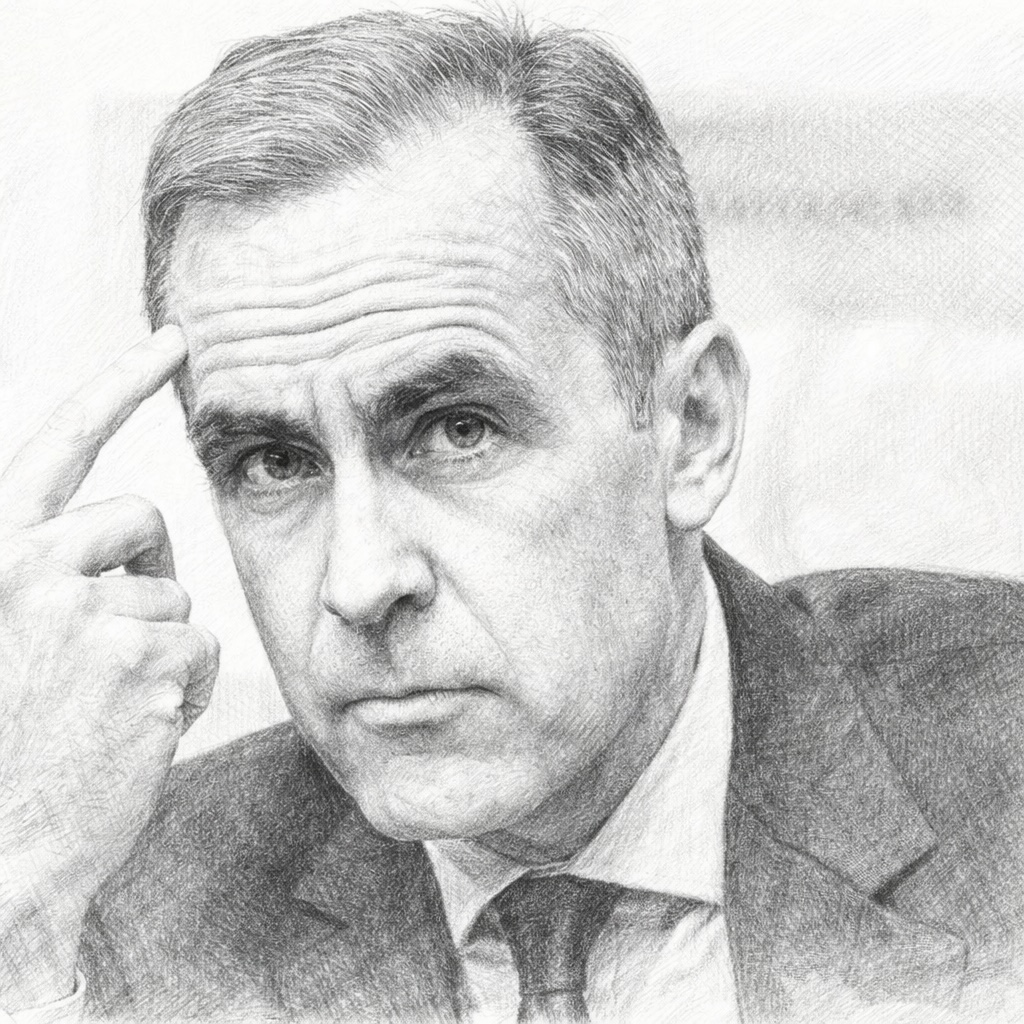
There is something genuinely unprecedented about Mark Carney's political emergence, and it is not what the financial press tends to celebrate. The Goldman Sachs alumnus turned dual central bank governor turned UN climate envoy turned Canadian Prime Minister is regularly framed as the apotheosis of technocratic virtue: sober where his contemporaries are histrionic, systemic where they are reactive, globally literate where they retreat to nativist fantasy. All of this is true, and none of it captures the deeper dialectic his career enacts.
What Carney actually represents is something the theoretical tradition has long anticipated and political commentary has been slow to name: the emergence of a new form of sovereignty-without-centre, a mode of governing that is neither the old Westphalian state-power nor the naïve cosmopolitanism that briefly passed for globalism in the 1990s. He is, in Fredric Jameson's resonant phrase, attempting a "cognitive map" of a totality that no longer has a legible geometry—and the problem is that the paper he draws on was manufactured by the very cartographic tradition whose maps have failed.1
To evaluate Carney seriously is to hold two registers simultaneously: the conjunctural (the specific political moment of post-Trump American unilateralism, Canadian trade vulnerability, and European strategic anxiety) and the structural (the deeper logic of what Hardt and Negri called Empire, the biopolitical management of populations, and the question of who constitutes the political subject of any post-hegemonic order). The conjunctural analysis has been done competently elsewhere.2 It is the structural register that demands attention.
Empire Without a Centre
Hardt and Negri's Empire (2000) made an argument that initially appeared counterintuitive and has since become unavoidable: the United States does not and cannot occupy the centre of Empire in the way that European imperial powers occupied the centre of their dominions. American hegemony was always, structurally, a network phenomenon—operating through multilateral institutions, financial architectures, legal norms, and military alliances rather than through direct territorial administration. As they argued, the sovereign power exercised through this network is not American imperialism in any classical sense; it is something genuinely new, a form of governance that distributes sovereignty across nodes while reserving override for the most powerful state actors.3
Trump's second administration represents not the exercise of that override power but something more structurally significant: an attempt by the United States to exit the network while retaining its benefits. The tariff regimes, the casual threats to Canadian sovereignty, the documented flirtation with Alberta separatism as a deliberate destabilization tactic aimed at punishing Ottawa—these are not misunderstandings of the rules-based order.4 They are an attempt to re-territorialize power: to reassert a Westphalian sovereignty that Empire's own architecture had rendered obsolete, and to use the resulting disorientation as leverage against former partners.
The U.S. Treasury Secretary's flirtation with Alberta separatism is less a mispricing of risk than a deliberate destabilization tactic. No amount of careful talk about resilience will deter that kind of behavior.
Carney Policy Review, Open Canada, 2026
This is the geopolitical context Carney has entered, and he has understood it more clearly than most of his counterparts. His repeated assertion that the post-war order "is not returning"—that economic integration has been weaponized and that middle powers must build new forms of collective resilience—is not merely a diplomatic repositioning.5 It is a structural diagnosis. When he describes tariffs and payment systems as "instruments of coercion" rather than natural market phenomena, and frames the new landscape in terms of "variable geometry"—different coalitions for different issues, overlapping rather than hierarchical—he is describing, without the theoretical apparatus, something close to what Hardt and Negri meant by the distributed sovereignty of Empire: a polycentric system of governance without a single uncontested centre.
What he has not yet fully grasped—and here Hardt and Negri's framework becomes diagnostic rather than descriptive—is that reconstituting a middle-power network still operates within the logic of Empire rather than against it. The question of who benefits from this reconstitution, and through what forms of political subjectivity, remains largely unasked within Carney's framework. His visits to Qatar and China early in his mandate, the active courting of European and Indo-Pacific partners, the framing of Canada as a platform rather than a proxy—these are the institutional moves of someone who has grasped that sovereignty in the current conjuncture is not a possession but a practice, not a territory but a network effect. But network effects can be captured and concentrated just as surely as territorial power, and the question of for whom this new network is constructed remains unresolved.
Cognitive Mapping at the End of Pax Americana
Jameson's concept of cognitive mapping, developed at length in Postmodernism, or The Cultural Logic of Late Capitalism (1991), proposes that a genuinely political art or politics requires the capacity to situate oneself within an otherwise unrepresentable totality. The postmodern condition, for Jameson, is defined by a fundamental spatial disorientation: individuals cannot locate themselves within the global systems that determine their lives, and this incapacity produces either political passivity or, in its reactive form, nationalist fantasy. "An aesthetic of cognitive mapping," he wrote, demands "a pedagogical political culture which seeks to endow the individual subject with some new heightened sense of its place in the global system."6
Carney's singular strength is that he is attempting this mapping in public, in real time, as a political leader. His Davos addresses, his parliamentary interventions, his framing of Canada's over-concentration on the U.S. market as a structural "weakness" rather than a natural given—all of these are cognitive mapping operations: attempts to make the systemic legible to publics habituated to treating it as given, natural, and beyond political agency.7 His crisis literacy, earned through the 2008 financial crash, the eurozone emergency, and the Brexit referendum, gives him an unusually dense set of coordinates. When he describes tariffs as instruments of coercion and weaponized interdependence as the new normal, he is performing exactly the kind of demystification that Jameson associates with a genuinely critical political culture.
Unlike some populist critics, Carney's response is not to retreat to autarky. It is to manage risk through diversification and institutional design. His comfort with probabilistic thinking makes him adept at explaining why a world of overlapping shocks requires structural changes rather than nostalgia or denial.
Reuters / Brookings composite analysis, 2026
But Jameson's framework also supplies the diagnosis of Carney's failure mode. The cognitive map Carney is drawing is calibrated to the instruments and scales available within what Foucault would call a neoliberal governmentality: stress tests, capital buffers, disclosure regimes, transition finance, trade diversification. These are tools of systemic risk management, not tools of political transformation. They can represent and perhaps stabilize the totality; they cannot change its basic coordinates. The map Carney offers is technically sophisticated and politically inert at precisely the level where disorientation is actually experienced: the level of wages, housing, cultural precarity, and the felt sense of democratic dispossession.
This is not an accident of political communication, as Carney's advisors sometimes suggest when they propose that he needs better "storytelling." It is a structural feature of the cognitive framework within which he operates. The language of resilience, diversification, and systemic risk is the language of a particular class fraction—the transnational professional-managerial class whose cognitive mapping is accurate from within one position in the system, and systematically blind from the positions of those who experience the system as pure violence rather than manageable risk.
The Governmentality Problem
Foucault's lectures at the Collège de France, published in English as Security, Territory, Population (2007) and The Birth of Biopolitics (2008), develop the concept of governmentality as the specific rationality through which populations are managed in modern liberal states. Neoliberal governmentality, on this account, is distinguished not by minimizing state power but by generalizing market rationality across all social relations: health, education, family life, subjectivity itself become domains of investment, risk calculation, and return. "The essential thing about this new art of government," Foucault argued, "is its enterprise logic"—the extension of the economic grid of intelligibility into every domain of human practice.8
The critique this framework enables of Carney is precise and pointed. His signature intellectual contribution—the alignment of capital markets with climate risk through disclosure regimes, stranded-asset pricing, and transition finance—is formally elegant and practically important. It is also, structurally, a deepening of neoliberal governmentality rather than its transcendence. To respond to the climate emergency by repricing risk across investment portfolios is to extend market rationality into the domain of planetary survival. The ecological crisis is rendered legible, and therefore governable, through the same epistemological apparatus that helped produce it.
The same structure applies to Carney's approach to trade diversification, industrial policy, and supply chain redundancy. These are responses to systemic risk framed entirely within the language of the system that produced the risk. Communities experiencing precarious work, regional deindustrialization, and the erosion of democratic policy space do not primarily need better macro-level risk diversification; they need a political economy that treats them as ends rather than variables, as constituents rather than populations to be managed. Carney's language, for all its systemic intelligence, consistently manages populations rather than constituting political subjects.
For communities living through industrial decline, Carney's climate-finance agenda sounds like more of the same: abstract capital flows determining their fate from afar, while they shoulder the social disruption of transition.
Economist analysis, January 2026
Foucault's analysis of the relationship between truth and power is also pertinent here. Carney's authority is credentialist through and through: it derives from his position within knowledge-producing institutions (Harvard, Oxford, Goldman Sachs, the Bank of England, the Financial Stability Board) and from his mastery of expert discourse. As Foucault argued in his genealogical work, "truth" in modern societies is always the product of a "regime of truth"—a set of procedures that authorize certain statements as knowledge while excluding others as mere opinion or sentiment.9 The Brexit campaign's "We have had enough of experts" named something real within this framework: a refusal of precisely this regime of truth and its claim to govern without democratic mandate. Carney's polished, data-driven style is not an accidental tic; it is the behavioral expression of a governing rationality that cannot easily appear otherwise.
The Multitude and Its Perverse Capture
Perhaps the most productive and underused theoretical frame for understanding Carney's predicament is Hardt and Negri's distinction, developed in Multitude (2004), between "the people" and "the multitude." The people, in classical political theory, is a unified subject constituted through sovereign representation: plurality reduced to singularity, diversity enrolled in a common will. The multitude, by contrast, is the actually existing plurality of productive subjects—workers, precarious laborers, the cognitively and affectively productive masses—whose cooperation generates the social value on which the system depends, but whose political form cannot be reduced to unity without suppression.10
Carney's political project, like most liberal multilateralism, addresses itself to "the people" as its subject: a Canadian people whose sovereignty must be defended, a coalition of middle powers whose collective interests can be institutionalized. This is constituted power—power that flows from and is authorized by a pre-existing sovereign subject. What he does not adequately theorize is the multitude: the actually existing heterogeneous plurality of those whose productive lives have been organized by and against the global order he is trying to repair.
The populist right, on this reading, represents not a misunderstanding to be corrected but a perverse capture of multitudinous energy: the genuine rage and disorientation of those who have experienced the costs of globalization without sharing proportionally in its returns, channeled into a politics of re-territorialization, ethnic exclusion, and authoritarian personality. Hardt and Negri, writing in Multitude, were already alert to this possibility—that the real productive energies of a population resistant to Empire's governance could be captured by reactionary rather than emancipatory politics. The rise of Trumpism and its European analogues is precisely this actualization.
Carney's approach tends to assume that rational risk-management language can coax great powers into more responsible behavior. But the current geopolitical moment is often driven by performative displays of power, historical grievance, and domestic political theater—not by technocratic assessments of optimal risk allocation.
Policy Magazine, Ottawa, 2026
Carney cannot defeat this political formation by out-arguing it. His instinct, when he engages with populist critique, is to acknowledge the legitimate grievances—hyper-financialization, erosion of national policy space, loss of democratic control over economic levers—while defending the institutional architecture those grievances are directed against. This is intellectually honest and politically insufficient. The multitude's energy cannot be managed through better institutional design; it requires what Gramsci called a hegemonic operation: the construction of a new common sense from within the lived experience of those whose common sense has been organized by the failing order. That is not a technocratic operation. It is a political one, in the deepest sense—and it requires a willingness to redistribute power, not merely to redistribute risk.
The Post-Colonial Deficit
Any claim to transnational leadership must grapple with the fact that "globalism" is heard very differently in Nairobi, Jakarta, or São Paulo than in Ottawa, London, or Brussels. Many states across the global South associate liberal globalization not with the prosperity it promised but with structural adjustment conditionalities, unequal trade architectures, and a pandemic during which vaccine nationalism exposed exactly whose lives the rules-based order was designed to protect. Carney's deep embedment in Western financial structures and elite policy forums—his biography as Davos Man par excellence—is not a neutral credential in these arenas.
To date, his agenda has leaned heavily on climate finance and rules-based cooperation, both of which are important and both of which can sound, from the perspective of the global South, like further lectures from the same institutions that administered earlier waves of austerity and structural conditionality. His stated aspiration to "variable geometry"—different coalitions on different issues—must therefore extend to genuinely different epistemic partners, not simply states that can be recruited into a coalition of anxious former American allies.
Strategically, genuine reorientation would involve championing governance reform in multilateral institutions—greater voting power for emerging economies at the IMF and World Bank, more equitable debt-restructuring frameworks, trade rules that permit industrial policy and climate-aligned development—rather than positioning Canada as an amplifier of G7 preferences within reformed packaging. The distinction matters: one is a genuinely post-colonial political economy, the other is managerialism with better optics. Carney has the intellectual capacity to see the difference. Whether his political formation allows him to act on it is another question.
The Conditions of Emergence
None of this is to say that Carney's project is worthless or that his emergence is without significance. Jameson, in his more optimistic registers, argued that genuine cognitive mapping—however partial and positioned—was politically more valuable than false consciousness or paralysis. Carney's systemic intelligence, his crisis literacy, his networked convening power, and his willingness to publicly name the failure of the old order are not nothing. They are, arguably, necessary conditions for what might eventually become adequate to the moment.
The question is whether they are sufficient. For Carney to become what the moment requires—not just a competent steward of a declining order but a genuine architect of something new—he would need to accomplish several moves that run against the grain of his formation.
He would need to move from risk management to political economy: to frame his project not merely as the reduction of systemic vulnerability but as the construction of a different relationship between capital, labour, and democracy. This is the difference between the Foucauldian governor of populations and the Gramscian organic intellectual who articulates the experience of those populations into a counterhegemonic vision. It is also the difference between a transitional figure and a foundational one.
He would need to listen to the multitude rather than manage it: to take seriously the energy within populist formations, distinguishing the genuine experience of dispossession from its reactionary political capture, and offering those who have been organized by the right an alternative political home. This requires not better storytelling but a substantive redistribution of power—over industrial decisions, over trade terms, over the costs of climate transition—toward those who have borne the externalities of the previous order.
And he would need to decolonize his epistemic framework: to actively invite the knowledge-formations of the global South into the design of any new institutional architecture, rather than simply inviting their endorsement of institutions designed without them. This is not a diplomatic courtesy. It is the condition of any globalism that can claim to be other than a reorganization of the same hierarchies under new management.
The Cartographer's Dilemma
Jameson closes his discussion of cognitive mapping with an image that remains prescient: the political intellectual as a cartographer who must draw maps of territories for which no adequate surveying tools yet exist, knowing that every map is both indispensable and distorted by the position of its maker. Mark Carney is attempting exactly this operation, at exactly the moment when the old maps have failed and the new territories have not yet stabilized.
His emergence is not, despite the financial press's enthusiasm, simply the return of responsible technocracy after a period of populist madness. It is something more structurally interesting: a figure produced by the logic of Empire attempting to govern its dissolution; a practitioner of neoliberal governmentality who has understood, at least partially, its limits; a Canadian prime minister who has seen clearly enough that the post-war order is gone to risk building something in its place. As one useful analysis put it, Carney has arrived as "perhaps the only major Western leader explicitly trying to salvage a constructive, rules-based globalism from the wreckage of post-Cold War hubris"—but the same traits that make him plausible also risk blinding him to the depth of what has to be remade.11
Whether what Carney builds constitutes a new political economy or merely the most sophisticated possible management of the old one's wreckage will be determined not by his intelligence, which is considerable, but by the pressure of the political subjects—the multitude, in Negri and Hardt's sense—who will ultimately decide what counts as governance and what counts as abandonment. The cartographer at the edge of Empire faces a fundamental dilemma: the very instruments that allow him to see the territory have been forged by those who drew its original boundaries. To map what comes next, he will have to set some of those instruments aside.
Whether he is willing to do so will determine whether his premiership is remembered as a transition or a foundation—as the last act of one order, or the first act of the next.
- Fredric Jameson, Postmodernism, or The Cultural Logic of Late Capitalism (Durham: Duke University Press, 1991), p. 54. Jameson's concept of cognitive mapping draws on Kevin Lynch's urban planning theory, extending it into a political aesthetics adequate to global capitalism.
- For the conjunctural framing, see: Reuters Breakingviews, "Mark Carney gives Davos Man a shot at redemption," March 10, 2025; The Economist, "Mark Carney understands the new world but can he survive it?", January 25, 2026; Policy Magazine (Ottawa), "From Reliance to Resilience: Mark Carney's Foreign Policy," 2026.
- Michael Hardt and Antonio Negri, Empire (Cambridge, MA: Harvard University Press, 2000), pp. xii–xiii. The argument regarding American network sovereignty rather than classical imperialism runs through the book's introduction and Part 1.
- On the Alberta separatism tactic, see Open Canada, "In Search of the Carney Doctrine: Canada's Foreign Policy in a Post-American World," 2026; NPR, "What's next for U.S.-Canada relations after Mark Carney's pointed speech at Davos," January 25, 2026.
- Mark Carney, remarks at the World Economic Forum, Davos, January 2026, as reported by the WEF and NPR. The phrase "not returning" is widely attributed across multiple accounts of the speech.
- Jameson, Postmodernism, p. 54. The full passage situates cognitive mapping as a response to the "impossible totality of the contemporary world system."
- The Guardian, "What can Canada expect from its next PM? The Mark Carney I knew," March 11, 2025; BBC, "Mark Carney: Canada's new prime minister," 2025–26.
- Michel Foucault, The Birth of Biopolitics: Lectures at the Collège de France, 1978–79, trans. Graham Burchell (Basingstoke: Palgrave Macmillan, 2008), p. 148. The "enterprise logic" formulation refers to the neoliberal reconstruction of social institutions on the model of the firm.
- Michel Foucault, "Truth and Power," in Power/Knowledge: Selected Interviews and Other Writings, 1972–1977, ed. Colin Gordon (New York: Pantheon, 1980), pp. 109–133. The concept of "regime of truth" is developed here and in the Collège de France lectures.
- Michael Hardt and Antonio Negri, Multitude: War and Democracy in the Age of Empire (New York: Penguin, 2004), pp. xiii–xvi. The people/multitude distinction is the organizing conceptual axis of the book's political theory.
- Perplexity/composite analysis of Carney's global role, as circulated in briefing form, 2026. The formulation is also echoed in Reuters Breakingviews (March 2025) and The Economist (January 2026).